
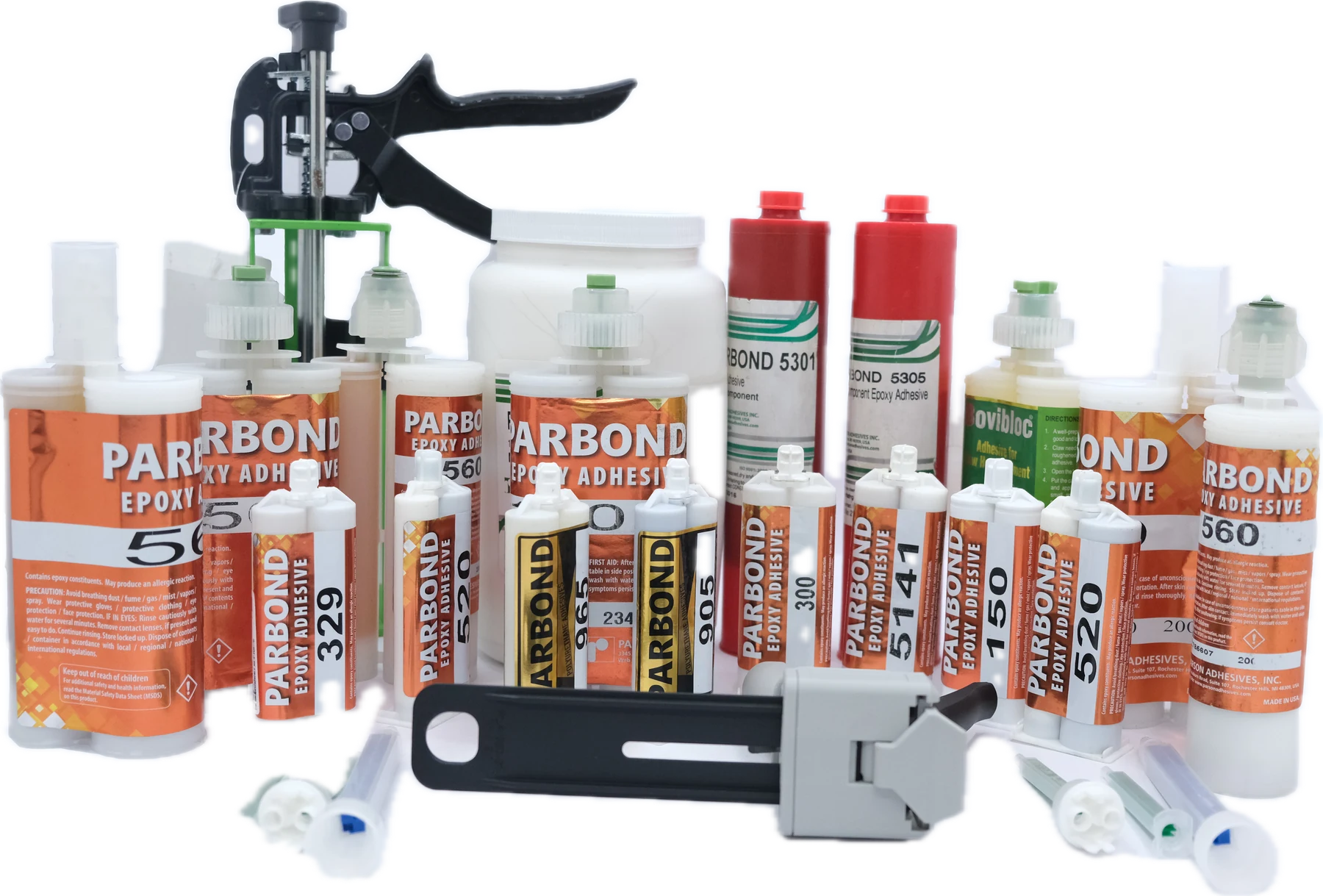
 PARBOND FAMILY SHOWN / PACKAGING VARIES BY GRADE
PARBOND / Epoxy adhesives · 2:1
PARBOND 520
High strength structural applications.
Request current TDSSelection depends on the actual materials, joint and service conditions. Confirm suitability before use.
APPLICATION / SELECTION
What to check
before selecting.
Selection considerations for PARBOND 520
Confirm the specified mixing ratio, suitable dispensing equipment and how complete mixing will be checked. Review the bond gap, substrate preparation and the time needed to position and fixture the assembly, then validate the cured joint under representative loads and exposure conditions.
Read the selection guide01 / TECHNICAL OVERVIEW
Technical properties
Typical properties from the available product literature. Values are tied to the stated test conditions and do not replace the current technical data sheet.
| Colour | Black |
|---|---|
| Viscosity at 25°C, cps | High Viscous Paste |
| Working Time (min) | 15–25 |
| Fixture Time (min) | 120–180 |
| Overlap Shear Strength (psi) | 3,000–4,000 |
Where data is incomplete or inconsistent across source documents, a value is not shown. Request the current TDS for final selection.
02 / DOCUMENTATION
Request documentation
Request the current TDS, safety data sheet or catalogue. Our team will confirm the relevant document and respond to your enquiry.
Need the current technical data sheet?
Include PARBOND 520 in your application brief and request the current grade-specific documentation.
Request technical data03 / BEFORE YOU SPECIFY
A product is part
of a process.
- 01Identify the exact substrates and surface condition.
- 02Define joint geometry, operating conditions and process time.
- 03Review the current TDS and safety data before handling.
- 04Validate the adhesive on representative assemblies.
CONTINUE EXPLORING
Related grades.
All PARBOND productsCONTACT PARSON
Make the next
connection.
Tell us how you plan to use PARBOND 520. Share the details that matter to your assembly.
Discuss an applicationsales@parsonadhesives.in